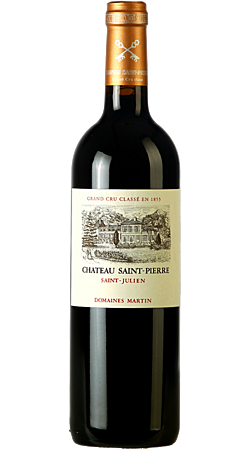
Saint-Pierre Castle, from the 18th century to the present day
Between division and unity
The history of the estate begins in the 17th century, when the Cheverry family acquired the property in 1693. In the 18th century, Baron Saint-Pierre settled in the castle and gave his name to the wine estate attached to it.
In 1855, the wine produced atSaint-Pierre Castleis placed among theFourth Classified Growth of the Saint-Julien appellationAfter this date, the vineyard was divided due to inheritance complications. Until 1852, the Château remained under joint ownership. It wasn't until the passion of the Belgian merchant, Mr. Van Den Busche, that the 17 hectares that comprised the estate were reunited in 1920.
In 1982, Henry Martin, the owner of Château Gloria, bought the estate. He passed it on to his daughter, who was married toJean-Louis Triaud, former president of the Girondins de Bordeaux club, she manages the estate with him.
The terroir of Saint-Julien
The Grand Cru Classé on a renowned terroir
It is in Bordeaux, in the heart of the commune ofSaint-Julien Beychevellethat we discover theSaint-Pierre CastleSurrounded by greenery, this Fourth Growth Classified wine is a blend of the region's three iconic grape varieties: Cabernet Sauvignon (75%), Merlot (15%), and Cabernet Franc (10%), which cover 17 hectares. The average age of these vines is 50 years, ensuring optimal quality for the wine.
Composed of Gunzian gravel over a clay-limestone layer, this terroir offers significant advantages to the grape varieties. The gravel has the unique property of releasing the heat it absorbed during the day at night. This prevents temperature fluctuations from disrupting the vine's development. The clay-limestone soil allows for excellent drainage, encouraging the roots to seek nutrients deep within the soil. As a result, the grapes harvested are bursting with the aromas of the terroir.
The wines of Château Saint-Pierre are all about subtlety.
The production of great wines for aging
After the grapes are harvested by hand, they are placed on tables for optical sorting. This step allows for selection with ahigh demandThe grapes. Following the Médoc winemaking method, the grapes are placed for fermentation in temperature-controlled stainless steel tanks. After a maximum of 15 days in these tanks, the wines are placed in French oak barrels for a period of 14 to 16 months.
The barrels are renewed by half every year to ensure the quality of the interaction between the wood and the developing wine. All the equipment was replaced and improved in the 1980s. It is in the cellar of theGloria Castle, completely renovated in 2015, is where the wines ofSaint-Pierre Castle.
At the tasting, subtle, charming, and oaky wines are revealed. The tannins offered by these red wines are fine and undeniably elegant.Fourth Growth Classifiedis exceptional and built for guarding.